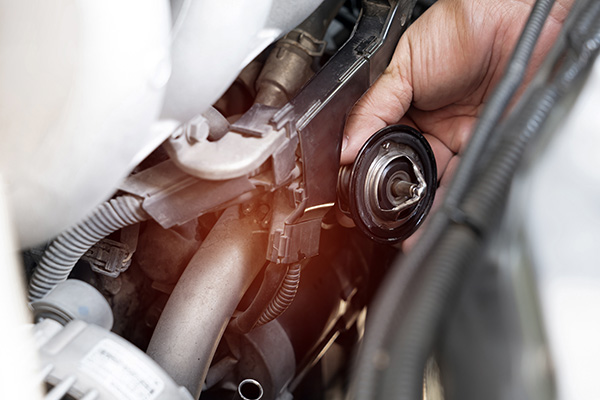
Your engine should warm up gradually and reach its normal operating temperature within a reasonable amount of driving. On a cold morning, that naturally takes longer, but if the temperature gauge stays low after twenty or thirty minutes on the road, something may be preventing the engine from holding heat.
You may notice weak cabin heat at the same time, especially at highway speeds. Fuel economy can also drop because the engine computer keeps treating the engine as though it is still warming up. When this becomes a regular pattern rather than an occasional cold-weather complaint, the cooling system deserves a closer look.
A Thermostat Stuck Open Is the Most Common Cause
The thermostat stays closed while the engine is cold so coolant can warm quickly. Once the engine reaches the proper temperature, the thermostat opens and sends coolant through the radiator.
If it sticks partly or fully open, coolant begins circulating through the radiator too early. The engine still warms, but much more slowly. At our shop, we often hear that the gauge rises while the car is sitting in traffic but drops again once the driver gets onto the highway. That pattern suggests a thermostat that allows too much cooling all the time.
Highway Driving Can Make the Problem More Obvious
A stuck-open thermostat can be easy to miss during short trips around town. At lower speeds, less air moves through the radiator, and the engine may eventually build enough heat to make the gauge look fairly normal.
Once you drive faster, a steady stream of outside air passes through the radiator. If coolant is already circulating through it when it should not be, engine temperature can fall noticeably. The heater may start blowing cooler air at the same time. That change between city and highway driving gives us useful information about how the thermostat is behaving.
Weak Cabin Heat Is Closely Connected to Engine Temperature
The heater does not create heat on its own. Hot engine coolant flows through the heater core, and the blower pushes air across it before sending that air into the cabin.
If the engine never reaches proper temperature, the heater core never gets as hot as it should. Common symptoms include:
- Heat takes a very long time to become warm
- Air from the vents stays lukewarm
- Heat gets cooler during highway driving
- The temperature gauge stays below its normal position
- The check engine light appears along with slow warm-up
- If the engine temperature is normal but cabin heat is still weak, we start looking at other possibilities such as low coolant, a restricted heater core, or a blend-door problem.
The Coolant Temperature Sensor Could Be Lying to the Computer
Sometimes the engine reaches normal temperature, but the vehicle reports something different. A coolant temperature sensor can send an inaccurate reading if the sensor itself fails or its wiring develops excessive resistance or a poor connection.
That can leave the dashboard gauge reading low even though the engine is fully warm. It can also affect fuel mixture, cooling fan operation, and other computer-controlled functions. During an inspection, we compare the reported temperature with the engine's actual temperature so we don't replace a thermostat that is doing its job.
Low Coolant Can Create Strange Warm-Up and Heater Symptoms
Low coolant does not always make an engine overheat immediately. If the system is low enough to pull air into the heater core or around the temperature sensor, readings and heater performance can become inconsistent.
You might get heat one minute and cooler air the next, or the gauge may move more than it normally does. If the coolant is low, the important question is why. Hoses, the radiator, the water pump, the thermostat housing, the expansion tank, and other connections can all leak. Simply adding coolant without finding the source leaves the problem waiting to return.
Cooling Fans Running Too Much Can Contribute to Slow Warm-Up
Electric radiator fans are controlled according to coolant temperature, A/C demand, and other operating conditions. They should not normally run at high speed throughout the warm-up period unless there is a reason for them to.
A stuck relay, incorrect sensor input, or control issue can keep the fans operating longer than necessary. A healthy thermostat should still restrict radiator flow while the engine is cold, so fan operation alone is not usually the whole problem. But when a thermostat is already weak, excessive fan operation can make slow warm-up much more noticeable.
Running Too Cool Is Not Harmless
Drivers tend to worry about overheating and ignore an engine that runs too cold, but the engine is designed to spend most of its time within a specific temperature range. Staying below that range affects how efficiently it operates.
The computer can keep the fuel mixture richer for longer, which can hurt fuel economy and increase deposits. Engine oil also takes longer to heat up enough to evaporate moisture on short trips. Regular maintenance helps catch thermostat problems, coolant leaks, and sensor issues before months of low-temperature driving become the vehicle's new normal.
Get Cooling System Service In Acworth, GA, With KAMS Auto Service
If your engine takes too long to warm up, the temperature gauge stays low, or the cabin heat gets weaker during highway driving, KAMS Auto Service in Acworth, GA, can check actual coolant temperature, thermostat operation, coolant level, sensors, and cooling fan behavior.
Schedule a cooling-system check so your engine can return to the temperature range it was designed to operate in.