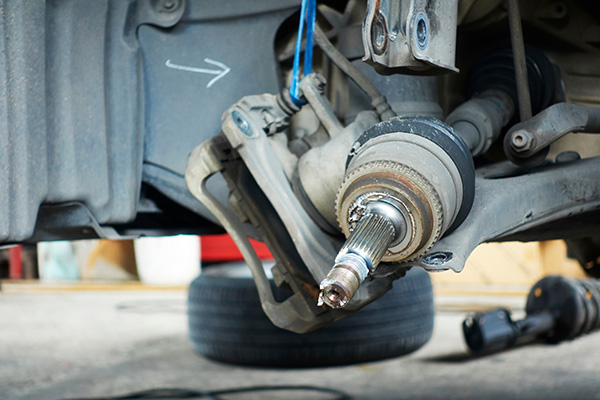
A torn CV boot sounds like a small rubber problem until you see what it protects. The car may still drive fine. No warning light, no major noise, no big puddle. Maybe there is only a little grease on the inside of the wheel.
That grease is the warning.
Once the CV boot opens up, the CV joint is no longer sealed. Grease gets out, dirt gets in, and the axle starts wearing in a way it was never meant to.
What The CV Boot Protects
A CV axle sends power from the transmission or differential to the wheels while still allowing the suspension to move and the wheels to turn. The joints at each end of the axle handle those changing angles. They work hard every mile, especially during turns and acceleration.
Inside each joint are metal surfaces packed with heavy grease. The CV boot wraps around the joint and keeps that grease in place. It also keeps out water, sand, road salt, and grit. When the boot is sealed, the joint can last a long time. When it tears, the countdown starts.
How A Torn Boot Starts The Damage
A torn boot usually does not instantly destroy the axle. That is part of what makes it easy to delay. The vehicle may run normally for a while because the joint still has some grease left.
The problem is what happens as the axle spins. Grease gets flung out in a circular pattern, often onto the wheel, control arm, strut, or splash shield. At the same time, road dirt starts sticking to whatever grease remains. That mixture turns into a gritty paste, and the joint begins wearing itself down from the inside.
A clean joint needs grease. A torn boot gives it sandpaper.
Early Clues Drivers Usually Notice
The first sign is often visual, not something you hear. Grease splatter near the inside of a wheel is one of the biggest clues. It may look like dark, sticky streaks or dots around nearby suspension parts. If you see that, the boot has likely been open long enough to throw grease.
You might also notice a small tear during tire service or while looking underneath the car. Sometimes the boot is cracked but not fully split yet. That is the best time to catch it, because the joint may still be clean inside.
A quick check during regular maintenance can spot these problems before the axle starts making noise.
When The CV Joint Is Already Wearing
Once the joint begins to wear, the symptoms become easier to feel and hear. A clicking or popping noise during tight turns is the classic sign of an outer CV joint problem. Drivers usually hear it in parking lots, U-turns, or when turning into a driveway.
Inner CV joint wear can feel different. Instead of clicking on turns, it can cause vibration or shudder during acceleration. The car may feel fine while coasting, but it may shake when you press the gas. That throttle-related vibration is a good clue because it indicates the axle is working under load.
If the noise or vibration is already present, the boot problem has likely progressed to joint damage.
Can You Replace Just The Boot?
Sometimes, yes. If the boot is torn but the joint is still quiet, clean, and has not been driven open for long, replacing the boot can make sense. The joint must be carefully inspected, cleaned, packed with the correct grease, and resealed properly.
That option depends heavily on timing. If the boot has been torn for weeks or months, dirt and water have likely gotten inside. A new boot will keep fresh grease in, but it will not undo pitted metal, worn grooves, or looseness inside the joint.
If the joint clicks, binds, or vibrates, replacing only the boot is usually money spent in the wrong place. At that point, axle replacement is usually the better repair.
What Damages The Axle Faster
A torn boot is bad enough on its own, but certain driving conditions accelerate the damage. Sharp turns under acceleration put more strain on the outer joint. Rough roads, potholes, and worn suspension parts put the axle through harsher angles. A lifted or lowered vehicle can also change axle geometry and add stress.
Engine and transmission mounts matter too. If a mount allows too much movement, the axle angle changes when you accelerate. That extra movement can make a weak CV joint complain sooner. We usually check the surrounding parts because replacing an axle without fixing the stress around it can lead to repeat problems.
A torn boot is the starting point. The rest of the vehicle decides how fast the problem grows.
Get CV Boot And Axle Repair In Acworth, GA, With KAMS Auto Service Center
If you see grease near a wheel, hear clicking on turns, or feel vibration when accelerating, KAMS Auto Service Center in Acworth, GA, can check the CV boots, joints, axle condition, and nearby suspension parts.
Schedule a visit before a small torn boot becomes a full CV axle replacement.